
December 2025
Sometimes, images lead us on pilgrimages we never intended to make. In two recent exhibitions in the US, the figure of the Black Madonna emerges not as a stable icon but through the act of looking itself—caught in fleeting visual encounters structured by reflection, surface, and material presence at a threshold between appearance and disappearance.
This essay is the first part of a duology reflecting on these encounters with the Black Madonna and their implications for the visual politics of gender and race. Although each exhibition can be experienced on its own terms, I gradually came to see them as moments of a single journey. In this first part, I follow the Black Madonna as she emerges through acts of mirroring at the Whitney Museum of American Art. The second part continues that journey at the Isabella Stewart Gardner Museum, where the Black Madonna unfolds through a constellation of materially distinct encounters.
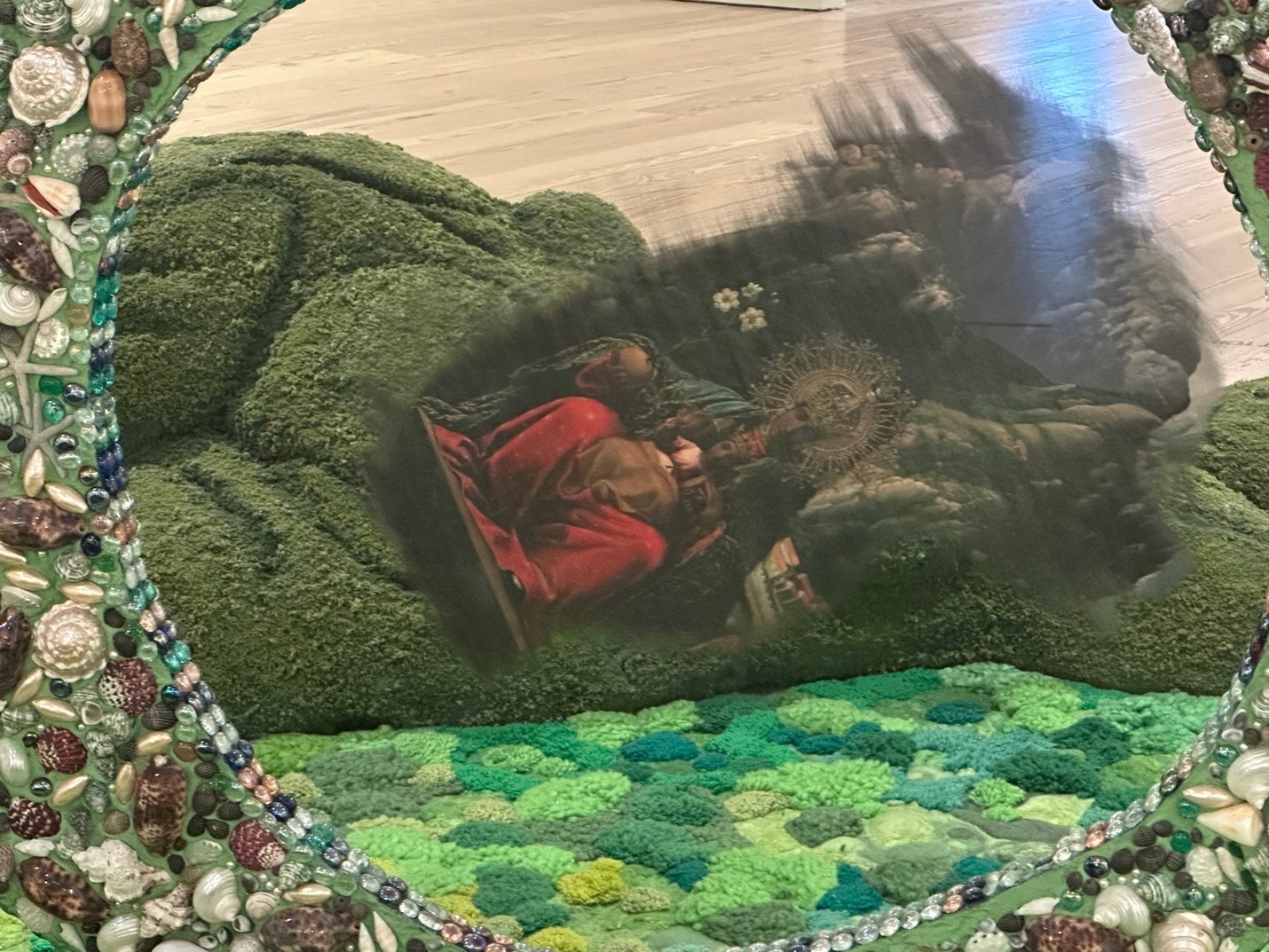
The Black Madonna first appeared not in an exhibition dedicated to her but almost by accident, in the opening room of the Whitney Museum of American Art’s “Shifting Landscapes” (New York, 1 November 2024–25 January 2026). There, Amalia Mesa-Bains’s reclining Venus in Cihuateotl with Hand Mirror (from Venus Envy Chapter III: Cihuatlampa, the Place of the Giant Women, 1997–2022) occupied the centre of the entrance gallery with an arresting presence, drawing the gaze into the material density of what first meets the eye (figure 1).[1]
Figure 1. Installation view of “Shifting Landscapes,” Whitney Museum of American Art, New York, 1 November 2024–25 January 2026. Partial view centred on the mirror in Cihuateotl with Hand Mirror from “Venus Envy: Chapter III, Cihuatlampa, the Place of the Giant Women” (1997–2022, Amalia Mesa-Bains). Overall dimensions: 49 × 126 × 151 in. (124.5 × 320 × 383.5 cm). Photograph by the author.
Amid the exhibition’s densely layered rooms—filled with works on migration, labour, and ecological precarity—the Venus lies in near-languor, reclining on a moss-like ground textured by eruptions of green. Yet this calm becomes quietly out of place when viewed in relation to the surrounding installation. Composed of lush mounds, her body is materially vulnerable, formed of a substance that could be consumed by fire at any moment. This vulnerability is sharpened by her proximity to Teresita Fernández’s Fire (America) 3 (2016), whose scorched horizon stages an image of ongoing combustion (figure 2). Reclining beside fire, the goddess remains strikingly indifferent. A body made of what can burn lies calmly beside burning itself, inhabiting a temporality in which impending destruction, as if incidental, slips past her.
Yet the wall text discloses a far more unsettling identity. She is Cihuateotl, an Aztec warrior-goddess and the spirit of women who died in childbirth, resting in Cihuatlampa, “the Place of the Giant Women.”[2] Leaning at an angle on the ground before her is a large mirror, its reflective surface encircled by a thick, shell-encrusted frame that forms a dense landscape of materials—spiral shells, fractured fragments, nacreous chips, tiny black knobs, glass-green beads, and the occasional curve of a conch—so tightly assembled that it resembles a living sanctuary of earthly matter (figure 3). The mirror may reflect at once the shell from which the Greco-Roman Venus emerged from the sea and the funerary shells that honour fallen female warriors. Up close, however, the overloaded tactility of its shell-encrusted surface arrests the viewer’s perception before it can settle into meaning.
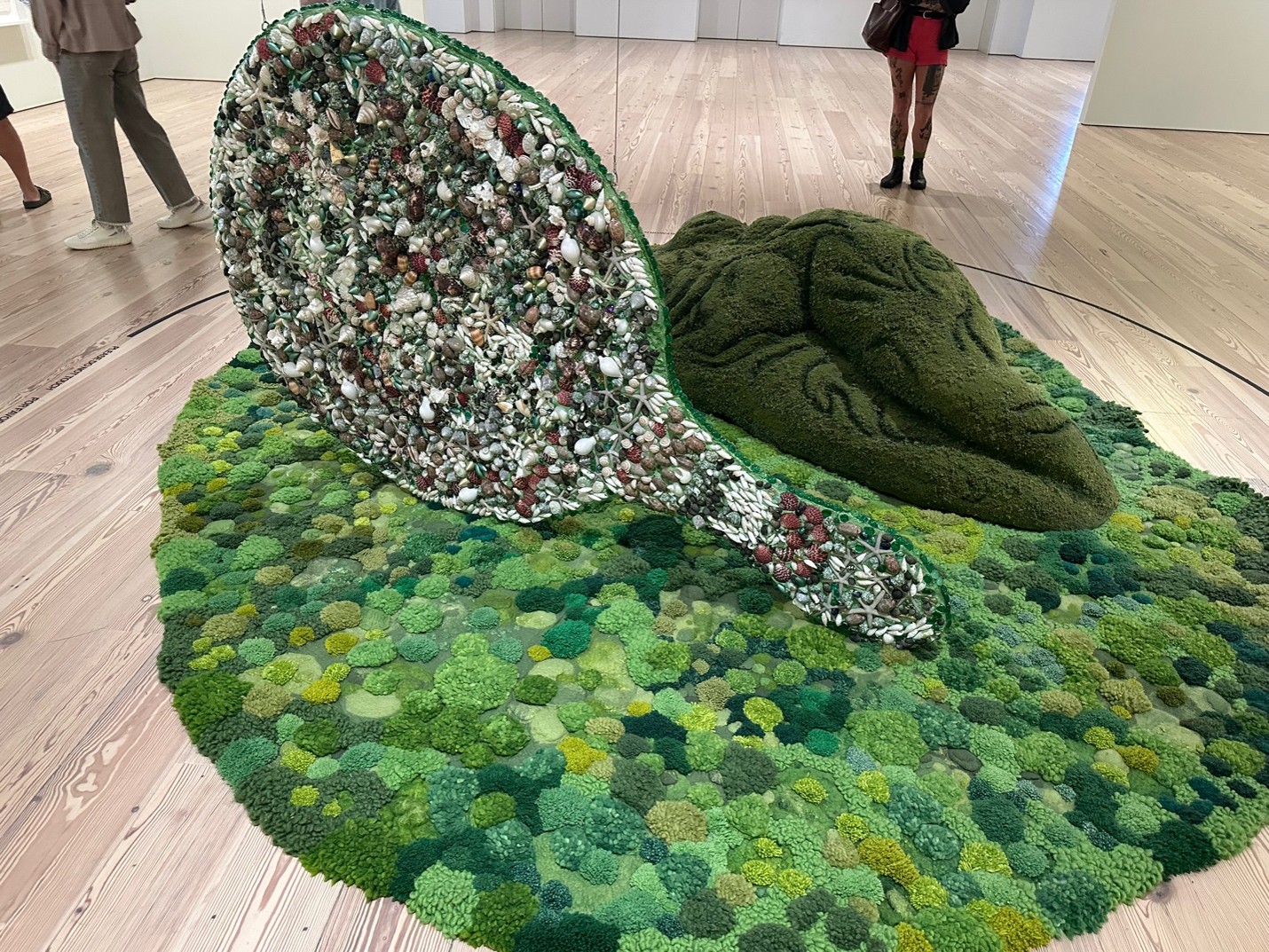
Figure 3. Installation view of “Shifting Landscapes,” Whitney Museum of American Art, New York, 1 November 2024–25 January 2026. Reverse view of Cihuateotl with Hand Mirror from “Venus Envy: Chapter III, Cihuatlampa, the Place of the Giant Women” (1997–2022, Amalia Mesa-Bains), highlighting the material construction of the mirror. Photograph by the author.
Confronting the charged, transformative force of the body in childbirth—a force in which creation remains inseparable from death—light traces the circling mirror frame’s materially excessive surface, introducing only a partial reflection of Venus’s body. Yet almost immediately, this same light flicks open another space by wiping itself across the mirror’s glass, as though a fogged window had been brushed clear by an unseen hand. Behind the reflective surface, a dark, frayed contour embedded within the mirror gathers only briefly, as if revealed by a hand wiping condensation from glass, before slipping away again. What appears in this fleeting interval is the faint image of the Black Madonna of Montserrat, a 12th-century wooden sculpture housed in the Santa Maria de Montserrat Abbey in Catalonia, Spain.[3]
How does this presence—shaped by centuries of devotion—interrupt the expected direction of looking toward Venus’s voluptuous body, a model of beauty that so often solicits a conceptually idealizing gaze? Here, the sacred overlays the sensual, not as an abstraction but as a mode of being in which looking hesitates, loosens, and enters into relation. The difficulty lies not in seeing her but in finding language for a presence that surfaces so delicately—almost before it can be named.
Weeks later a related exhibition appeared at the Isabella Stewart Gardner Museum: “Visions of Black Madonnas” (Boston, 23 October 2025–19 January 2026), devoted to the figure of the Black Madonna. There, the Black Glass Madonna of Loreto (1570–1591) is placed in dialogue with 20th-century works by the Boston artist Allan Rohan Crite. This dialogue unfolds across three parallel installations at the Gardner: “Visions of Black Madonnas” in the Fenway Gallery and “Allan Rohan Crite: Urban Glory” (23 October 2025–19 January 2026) in the Hostetter Gallery—the latter foregrounding Crite’s strategies for representing the sacred as embedded within the spaces of his local neighbourhood—alongside Robert T. Freeman’s commemorative installation, Allan Crite—American Griot (2025), presented on the Anne H. Fitzpatrick Façade (14 October 2025–10 February 2026), mentioned for context, but not explored further.
In Cihuateotl with Hand Mirror, Amalia Mesa-Bains allows the tension between seeing and the seen to crack open from within the image itself. Across Venus’s moss-covered surface, ambiguous lines—ridgelines, scars, markings, perhaps tattoos—cut across her form like traces of a mythological wound, oscillating between ornament and injury, decoration and damage. Through this fissured surface, the figure of Venus—long tied to idealized frames of sensual embodiment—is quietly undone from within. Yet the mirror introduces a more difficult configuration. A single female body becomes the meeting point of visual identities that resist neatly bounded categories: Venus, Chicana woman, a warrior-goddess for women who died in childbirth, and, through the mirror, Black Madonna. The visual politics of the work lie not in the juxtaposition of these identities but in bringing them into a mirrored relation, where they confront, reflect, and deflect one another. It is in these shifting relations that Venus becomes Chicana, a Chicana body inhabits the pose of Venus, and sensual femininity encounters sacred maternity in the mirror.
The first layer of this mirrored relation concerns the unexpected proximity between sensuality and maternity through Venus’s reflected identity as the Madonna. Contrary to the distance that Western visual culture has long maintained between sensuality and maternity, when viewed from the standpoint of embodied and earthly female experience, sensuality and maternity belong to a continuum in which sexuality, childbearing, pain, and mortality converge. This continuum becomes more complicated when we consider where life and death are located. In Christian imagery, Mary gives birth to her Son and later confronts the immeasurable grief of His death, a maternal suffering through which the Madonna and Pietà have acquired their enduring devotional power in art. Through Venus’s reflected identity as the Madonna, another dimension of female experience comes into view: here, it is the woman herself who dies in the act of childbirth. The juxtaposition with the Madonna is especially revealing because this reflected identity relocates life and death within the female body even as the mother’s grief at the death of her Son remains observable. Her reflection between the Madonna and Venus recasts childbirth less as the miraculous birth of a child than as an event endured by the female body at the risk of her own life, where sexuality, childbearing, pain, and mortality converge—dimensions of female life that neither Venus nor the Madonna can fully contain.
The second layer emerges through the hidden identity of this Venus-posed figure, revealed through her reflection as the Black Madonna: Cihuateotl. This introduces race and the material politics of distance and proximity. Placed against the long history of racializing non-white women, the sacred presence of the dark female body raises a difficult question: How can perceived difference be used to diminish the female body as primitive while also investing a sacred dark female body with powers imagined to exceed the ordinary?[4]
Here, two histories collide: the racialization of the non-white female body through notions of primitive fertility, and the active pursuit of the dark sacred female body as a source of miraculous power. The contradiction becomes material. Black Madonnas have long been approached not merely as images to be seen but as sacred presences sought out through pilgrimage, ritual encounter, and the hope for miraculous healing.[5] This long history of devotion reveals a striking paradox. The same visual culture that has made darkness available as a sign of otherness can, in another sacred context, make physical proximity to a dark female body the object of intense desire and hope. Within the constellation of female identities brought together in Mesa-Bains’s work, the Black Madonna may thus be othered and needed at once—not only within vision, but through the very desire for contact with her material presence. Mirroring here does not simply equalize the gaze. It exposes the asymmetries embedded within the stratified structures of the female body that Western visual culture has long kept apart and valued unequally: physically desired sexuality and motherhood, maternal mortality and sacred maternity, and racialized fertility and the sanctified presence of the Black Madonna.
A third layer emerges as we return to the vegetation-covered body from which this visual movement began. Yet we return to it differently. Having followed the mirror across Venus, Chicana woman, Cihuateotl, and the Black Madonna, we now encounter the moss-covered body as an anthropomorphic landscape, in which the body operates as landscape and the landscape becomes legible through the body. The merging of the human body and natural form has a long visual history. In early modern anthropomorphic landscapes, hills, rocks, and vegetation could become faces and bodies, making the human and the natural visually interchangeable.[6] Landscape becomes an inseparable part of the pictorial subject rather than a passive backdrop: the body operates as landscape, while landscape is read through the body.
Mesa-Bains takes this tradition into more politically charged terrain. The vegetation-covered Chicana Venus becomes the point at which a series of historically unequal binaries intersect. The opposition between man and woman has historically expanded into broader divisions between humanity and nature, culture and body. When colonial hierarchy enters this structure, another axis emerges: Western versus non-Western, culture and civilization versus nature and the primitive. These binaries are made to extend and reinforce one another, allowing historically unequal structures to accumulate within a single body.
More decisively still, this vegetation-covered body is not only seen; she sees. The female figure historically aligned with nature and made available to vision now holds the mirror herself. She becomes the viewing subject, directing vision beyond her own body and bringing the Black Madonna into view. Through this reflected encounter, another binary begins to unravel: the sacred and the material. The sacred power of the Black Madonna is experienced not despite her material presence but through it. Material presence becomes the very means through which sacred power is encountered.
Through these intersecting visual structures, Mesa-Bains unexpectedly transforms the meaning of Shifting Landscapes: the landscape shifts because the body does. Her body becomes a “shifting landscape.” in which the very binaries that have historically divided bodies, cultures, nature, and the sacred confront and negotiate one another. This embodied landscape gives unexpected visual structure to the Whitney’s expanded notion of landscape, as the tensions inscribed within the Chicana Venus project outward, implicating the exhibition space as a whole. The moss-covered body appears simultaneously as a mirrored body—where bodily fracture, spatial exchange, and reflective instability converge—and as an anthropomorphic terrain: an embodied landscape in which mythological, sacred, and contemporary visual regimes partially overlap, fracture, and interrupt.
In this configuration, mirroring no longer functions as a one-to-one relation between body and reflected image. The Black Madonna does not appear as a stable reflection; she gathers momentarily at the mirror’s threshold, emerging lightly before dispersing again. This spatial instability is reinforced by the work’s installation history: Venus and the mirror did not originate as a unified ensemble but first existed as separate elements, only later brought into relation.[7] The sacred—the Black Madonna as reflected presence—does not arrive from elsewhere; it surfaces precisely at the point where representation can no longer hold together.
This internal fracture is amplified by scale. Mesa-Bains’s Chicana Venus exceeds containment, refusing the domestic, devotional, and architectural structures historically used to frame the colonized female body.[8] The mirroring at work here can be related to early modern approaches to reflective space, including those articulated by Diego Velázquez’s Venus at her Mirror (c.1647–51), in which mirroring intensifies uncertainty rather than resolving it. In this painting, the viewer initially encounters the expansive surface of Venus’s back, which anchors the pictorial field and situates the mythological body as the point of entry into the image. Yet the mirror—much smaller in scale than Venus’s body—is enough to unsettle this initial stability. Within it, the faint reflection of her face appears blurred yet intimate, closer to the face of a real woman than to that of a mythological goddess, and thus unexpectedly closer to the viewer’s own space of actuality than to the imaginary space of myth.
Through the mirror, mythological space and the viewer’s real space neither merge nor stand in opposition. They briefly touch across the mirror’s surface, producing a moment of perceptual instability without collapsing into a unified whole. Instead of forming closure, the mirror quietly opens a fissure within representation itself, drawing the act of looking into question. This spatial instability corresponds to what Rose Marie San Juan describes as the early modern mirror’s “vertiginous” capacity—a condition in which seeing becomes inseparable from being seen.[9] Its critical implication lies in a bi-directional transformation of representation: the reflected image begins to exert a form of agency, while Venus, as the presumed subject of vision, no longer occupies a fully coherent position. Within this exchange, the reflective surface itself assumes a quasi-subjective role, destabilizing the hierarchical relation between image and beholder.
Mesa-Bains’s Venus—with her calm indifference and mirrored body—thus becomes a figure of this condition: poised between inclusion and withdrawal, between seeing and being seen, as though the mirror does not simply return an image but quietly transforms the act of looking itself. Within this configuration, mirroring ceases to function as a device of equivalence. Appearance becomes inseparable from disappearance: presence registers only through delay, deferral, and partial return.
Given the work’s prominent position at the centre of the exhibition’s entrance gallery, its transformative structure of mirroring seems especially open to further interpretive extension. Mesa-Bains’s mirror space—with its interplay of emergence, spectatorship, and devotional afterlives—might thus be understood as a conceptual hinge for the exhibition as a whole: a way of thinking about shifting landscapes not only as geopolitical or ecological terrains but as spaces of reflection and embodied vision. In this sense, the Black Madonna activates what Michael Baxandall once described as the “period eye”—not as a fixed visual code but as a historically contingent set of perceptual conditions, materially activated and continually reconfigured by the contexts in which images appear.[10] What surfaced in the Whitney’s mirrors was not simply an image but a mode of attending shaped by unstable relations between seeing and being seen, mediated through reflection. The reflected image thus exceeds the boundaries of a single exhibition, drawing the viewer toward another site of encounter.[11]
What connects the two exhibitions is not simply the recurrence of the figure of the Black Madonna, but a shared mirroring structure through which the sacred becomes intermittently perceptible—surfacing, withdrawing, and returning across distinct contexts of looking. Both exhibitions unfold within established centres of the global art world—New York and Boston—yet this shared structure brings into view a shifting boundary between centre and margin, sacred and profane. Rather than rehearsing the familiar narrative in which the centre preserves authority while the margin incubates innovation, the mirroring at work across these exhibitions complicates that structure. The Black Madonna emerges as a figure that unsettles such binaries—not by occupying a fixed position but by appearing through moments of perceptual relay—at once central and peripheral, radiant and withdrawn, materially grounded yet elusive.
If the Whitney introduced the Black Madonna primarily through reflection—an image appearing indirectly and belatedly through the ephemerality of surfaces—the Gardner exhibition (as discussed in the second part of this duology) continues that journey through black glass and paper. There, the Black Madonna reappears through the reflective density of black glass and, in Crite’s Black Madonnas, across the thin surface of paper, where sacred presence quietly emerges through the architecture of everyday life.
[1] See the Whitney Museum’s exhibition trailer (especially 00:04–00:25), which captures the spatial encounter discussed here, from the moment Mesa-Bains’s work first comes briefly into view at the entrance until the camera moves into the next gallery.
[2] Whitney Museum of American Art, Shifting Landscapes. Exhibition wall text, Whitney Museum of American Art, New York, 1 November 2024–25 January 2026.
[3] M. Oleszkiewicz-Peralba, The Black Madonna in Latin America and Europe: Tradition and Transformation (Albuquerque: University of New Mexico Press, 2007), pp. 158, 161.
[4] Sander L. Gilman, ‘Black Bodies, White Bodies: Toward an Iconography of Female Sexuality in Late Nineteenth-Century Art, Medicine, and Literature’, Critical Inquiry, 12.1 (Autumn 1985), pp. 204–242, pp. 213–16.
[5] Monique Scheer, ‘From Majesty to Mystery: Change in the Meanings of Black Madonnas from the Sixteenth to Nineteenth Centuries’, The American Historical Review, 107:5 (2002), pp. 1412, 1416, 1421–22, 1425–27.
[6] Rose Marie San Juan, Vertiginous Mirrors: The Animation of the Visual Image and Early Modern Travel (Manchester: Manchester University Press, 2011), pp. 56–67.
[7] L. E. Pérez and M. E. Fernández (eds.), Amalia Mesa-Bains: Archaeology of Memory (Oakland: University of California Press, 2023), plate 16.
[8] El Museo del Barrio, DOMESTICANX: Conversation with Amalia Mesa-Bains, YouTube video, 2025, accessed 27 September 2025; J. A. González, “Unruly Erotic,” in L. E. Pérez and M. E. Fernández (eds.), Amalia Mesa-Bains: Archaeology of Memory (Oakland: University of California Press, 2023), pp. 61–65.
[9] Rose Marie San Juan, Vertiginous Mirrors: The Animation of the Visual Image and Early Modern Travel (Manchester: Manchester University Press, 2011), pp. 30–47.
[10] Michael Baxandall, Painting and Experience in Fifteenth-Century Italy: A Primer in the Social History of Pictorial Style (Oxford: Oxford University Press, 1972), pp. 29–40.
[11] W. J. T. Mitchell, What Do Pictures Want? The Lives and Loves of Images (Chicago: University of Chicago Press, 2005), pp. 28–35.
Installation view of “Shifting Landscapes” (Whitney Museum of American Art, New York, 1 November 2024–25 January 2026). Partial view centred on the mirror in Amalia Mesa-Bains. Cihuateotl with Hand Mirror from “Venus Envy: Chapter III, Cihuatlampa, the Place of the Giant Women” (1997–2022), overall 49 × 126 × 151 in. (124.5 × 320 × 383.5 cm). Photograph by the author.
Dr Sena Lee is a New York-based art historian who received her PhD in History of Art from University College London. Her research explores how mythological pictorial space was re-framed in seventeenth-century Italy and Spain through the intersection of different visual languages of painting (such as layering, splitting, mirroring, and framing). More recently, she has extended this approach to contemporary visual culture, examining the structures that emerge through the intersection of museum display, sacred imagery, and race.
Sena Lee, “Mirroring the sacred (I),” JVC Magazine, 19 July 2026, https://journalofvisualculture.org/mirroring-the-sacred-I/.