
December 2025
In the first part of this duology, I explored how mirroring in Amalia Mesa-Bains’s Cihuateotl with Hand Mirror brought Venus, Cihuateotl, and the Black Madonna into a shifting constellation through which the sacred emerged at the intersection of race and gender. In Part II, I move on to the Isabella Stewart Gardner Museum, where the Black Madonna reappears through the luminous depth of black glass and the materially lean surfaces of Allan Rohan Crite’s works on paper, opening the sacred as a space where the politics of racialized and gendered difference is reworked.
Reflection can become almost graspable. At the Gardner, the Black Madonna unfolds across three sites—the exhibition “Visions of Black Madonnas,” the usual location of the Black Glass Madonna of Loreto (1570–1591) in the Veronese Room, and “Allan Rohan Crite: Urban Glory”—each staging a distinct play of presence and absence within the mansion’s architecture.
The journey begins in the Fenway Gallery with Bartolomeo Bulgarini’s The Virgin and Child Enthroned with Saints and Angels (c. 1355), a gold-ground panel painting where the sacred emerges as gold meets light across the painted surface. Against the radiant ground, the angels’ halos and those of the Virgin and Child appear almost pressed into the panel, while thin layers of tempera render flesh with a muted tactility. The painted skin rests lightly on the gold, separated by a tenuous sacred membrane rather than fully absorbed into it. Here, the sacred appears not as transcendence but as proximity, experienced through the contact of surface and illumination.
Before encountering the Glass Madonna herself, this material condition extends into a tactile prelude. Viewers are invited to handle transparent glass rods produced through Venetian glassmaking techniques, experiencing the weight and density of worked glass at close range, while the Madonna’s glass face and mould stand nearby. Set against accounts of Black Madonnas whose darkness has often been attributed to prolonged devotional use—including the soot and smoke of candles and incense—this passage foregrounds blackness as a material decision.[1] If the Whitney introduced the Black Madonna primarily through reflection—an image appearing indirectly and belatedly through the ephemerality of surfaces—then the Gardner offers her through the full force of material presence.
Black glass here is not simply reflective; it holds, traps, and thickens light. Where reflection produces an image through deferral, glass asserts itself as substance—luminous, dense, fragile, and historically saturated. Here, reflection gives way to material presence, as though what first flickered at the threshold of perception has arrived as something weightbearing and insistently present.
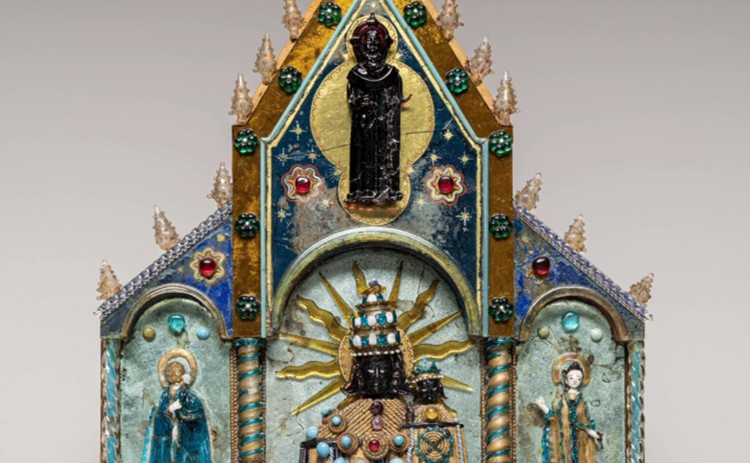
When the Glass Madonna finally comes into view, her face—formed of black glass, like that of the Christ Child—is small in scale yet optically commanding (figure 1). Tiny white glints animate the dark surface, giving the eyes an intensity that seems to return the viewer’s gaze. Unlike gold, which radiates outward, black glass absorbs light only to release it selectively, holding light in suspension before returning it in fleeting flashes—a mirroring through which the sacred briefly glows before dissolving into shadow. At this moment, black glass reveals a capacity not simply to reflect but to mislead vision, setting in motion a bidirectional transformation between image and viewer. Deeply recessed eyes and cheeks catch reflected light, appearing almost white and producing the uncanny impression of a pale gaze directed sharply outward, startlingly alive. The Madonna’s slightly downward, carved gaze turns this visual misreading into a vertiginous oscillation between looking and being looked at, producing a devotional experience of suspension and self-reflection through the flickering translucency of black glass.[2]
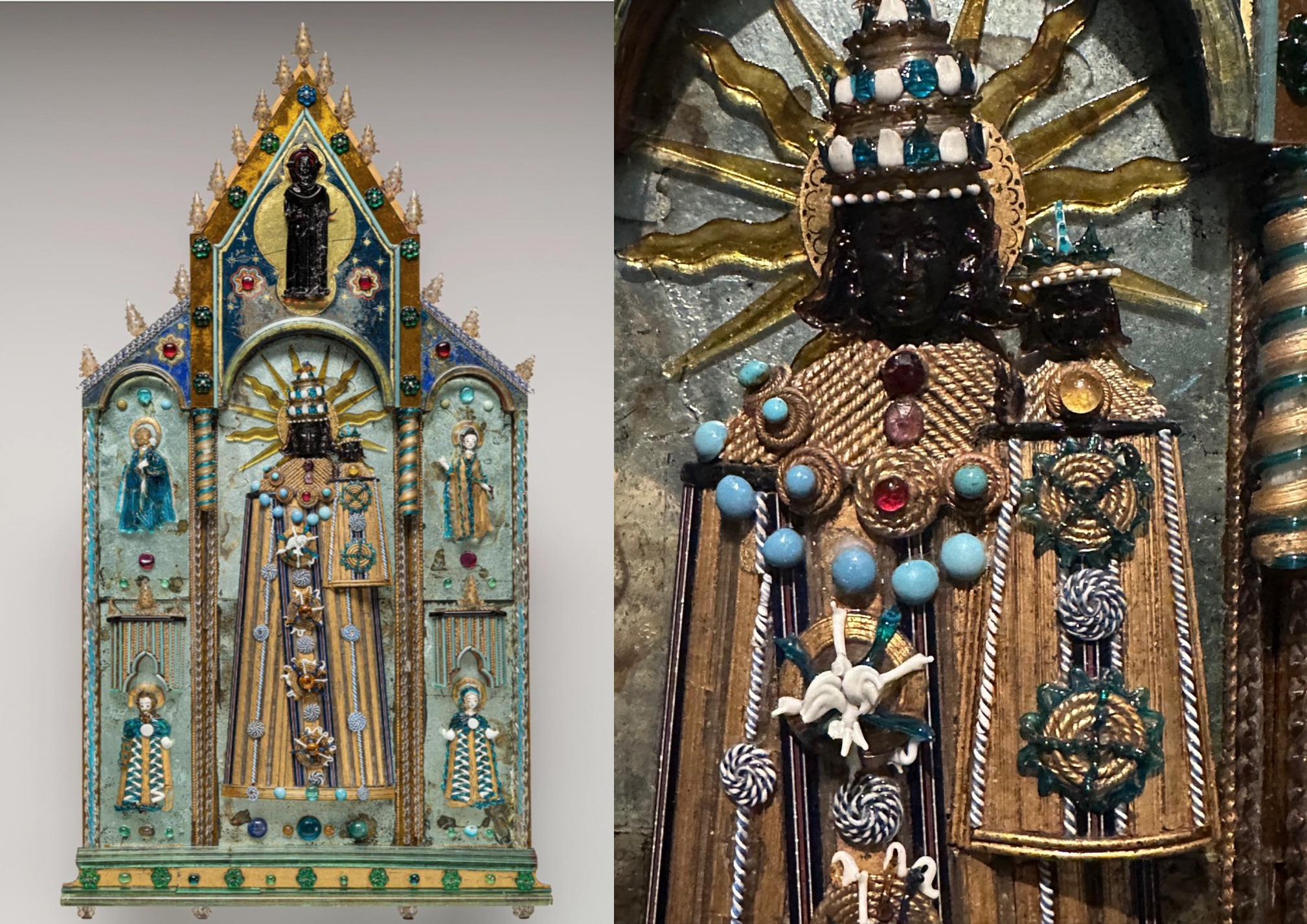
Figure 1. Left: Black Glass Madonna (1570–1591), Innsbruck Court Glassworks (active Innsbruck, 1570–1591). Lampworked and pressed glass on wood mount, 52.5 × 28.8 cm (20 11/16 × 11 5/16 in.). Isabella Stewart Gardner Museum, Boston. Image courtesy of the Isabella Stewart Gardner Museum. Right: Detail view of Black Glass Madonna (1570–1591).
This emphasis continues across the Madonna’s body, where gold constructs sacred presence in a different way from Bulgarini’s panel. Rather than a continuous surface, her body is constructed through densely striated gold threads, lending it an abstract triangular coherence, while the Christ Child is rendered even more reductively, approaching a triangular prism. Against this abstraction, dense ornamentation clusters around a heart-like red gemstone, interwoven with blue stones and varied materials. Depth emerges not through perspectival recession but as materials advance toward the viewer, producing a tactile density in which surface and volume press forward together.
The reflective capacity of black glass resonates throughout the material world around her, turning looking itself into a charged, reciprocal act. Surrounded by different faces and a profusion of glass, gold, turquoise hues, and dense, jewel-like ornamentation, the Black Madonna emerges within a cross-historical constellation of material sanctity. Among the four flanking figures, a sculptural face in gold finds an unexpected counterpart in a female saint whose features evoke an East Asian physiognomy. They stand upon translucent glass tinted blue and brown, oscillating between atmosphere, shallow water, and mirror, as if suspended between emergence and dissolution. The Madonna’s luminous depth thus extends through this fragile constellation, where darkness and luminosity, weight and fragility coexist.
Next to the Black Glass Madonna, a small plaque introduces Crite’s print Untitled (Madonna and Child) (1984) through the language of mirroring: the mother-and-child pairs “have mirrored poses” (figure 2).[3] Articulating Crite’s approach to human interconnectedness through “traditional elements of Madonna and Child imagery,” including “seated poses, halos, and gold leaf,” the curatorial text traces formal correspondences across figures from West Africa, Southeast Asia, and North America. [4] Yet, reflecting on the Black Glass Madonna, whose dark surface gathers, transforms, and returns what comes before it, I suggest that mirroring can be extended beyond formal resemblance. Across the thin paper surface, the sacred emerges relationally, shaped by adjacency, alignment, and repetition, as one figure becomes visible through another. What is mirrored, then, is not simply form but the pictorial structure through which figures come into view.
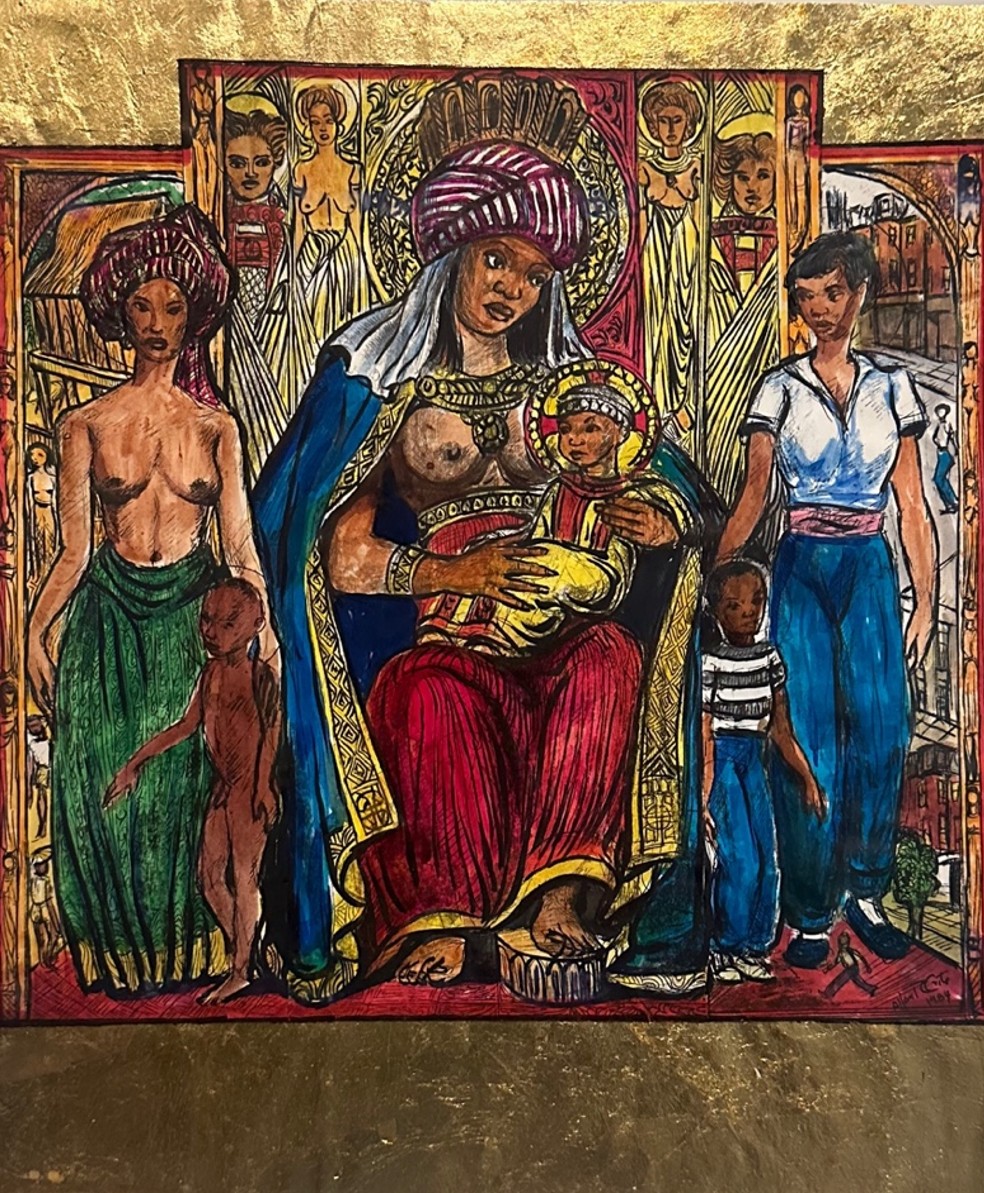
Figure 2. Untitled (Madonna and Child) (1984, Allan Rohan Crite). Hand-coloured and gilded multilith print, 41.3 × 34.9 cm (16 1/4 × 13 3/4 in.). Collection of Susan Thompson. Image courtesy of the Allan Rohan Crite Research Institute and Library.
Upstairs in the Veronese Room, the visitor encounters the Black Glass Madonna’s usual location, where its empty frame marks the sculpture’s temporary absence during the exhibition (figure 3). The sculpture has been removed, but the frame remains, preserving the site of her former presence. This absence sharpens attention to the space itself. The dense orchestration of textiles, leather walls, frescoes, and furnishings—drawn from multiple periods and regions—renders the withdrawal of the figure strangely radiant, as though the room itself had absorbed her devotional charge.
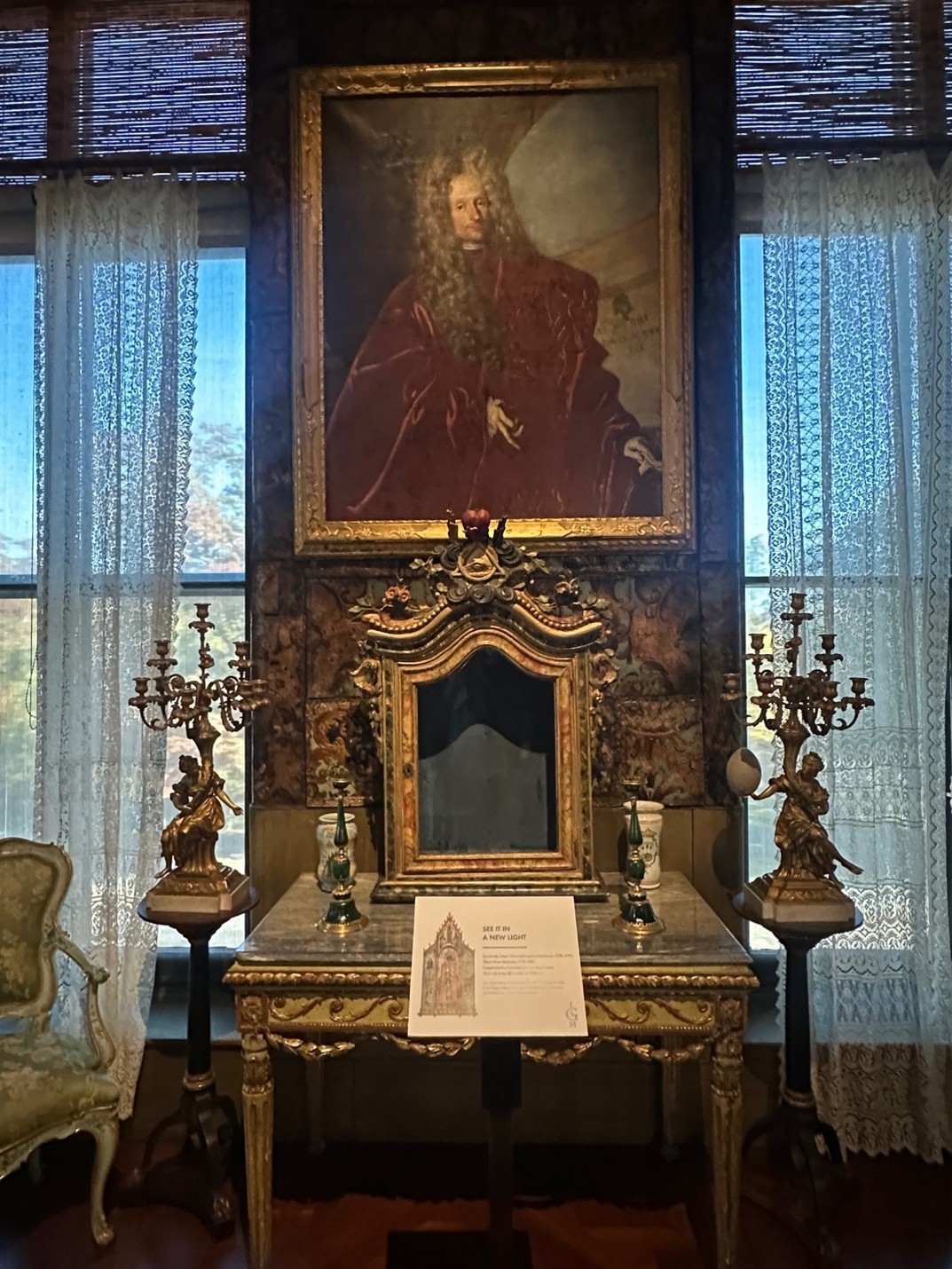
Figure 3. Installation view of the Veronese Room, Isabella Stewart Gardner Museum, Boston, showing the original niche and spatial framing of the Black Glass Madonna. Photograph by the author.
Across the mansion, each Madonna and Child—Black or otherwise—summons the sacred through material presence: the earthy grain of terracotta, the dark stone that absorbs rather than reflects light, the cracked gilding of a panel painting exposing its pale wooden underlayer. Each surface becomes a vessel through which devotion is enacted. The sacred remains inseparable from its material substance. No longer confined to vision, the Madonna’s embrace gathers the diverse materialities of earthly life into sacred presence.
Standing before the empty niche where the Loreto Black Glass Madonna usually resides, one notices that her absence is framed by another presence: the portrait of Archduke Ferdinand II suspended above the shrine. This configuration produces a double visibility: the Madonna’s withdrawal and the reappearance of the patron who placed her there. The empty frame thus becomes a quiet site where layered acts of authorship remain visible, though unspoken. More strikingly, the temporary removal of the Madonna unexpectedly reveals Gardner’s curatorial authorship—not only as collector but also as the creator of the mansion’s spatial world. Gardner conceived the museum not as a chronological display but as a spatial constellation in which the sacred remains materially grounded while continually transformed through surface, light, and proximity.[5]
Seen in this way, the Black Madonna belongs to the Gardner not as a figure reducible to identity politics but as part of a multiplicity of spaces through which she continually reappears—through glass, gold, absence, framing, and repetition. This multiplicity does not negate race or identity; it situates them within broader spatial relations that condition their emergence. Crite’s Black Madonna thus enters the Gardner as a continuation of this longer history of material sanctity, in which the sacred takes form through matter rather than transcending it.
Finally, in the “Allan Rohan Crite: Urban Glory” exhibition, housed in the Hostetter Gallery, the Black Madonna reappears as a fragile presence tucked among the figures in Crite’s scenes of neighbourhood life across the cityscape of Boston. The sacred emerges not through spectacle but through its quiet insertion into everyday life. The exhibition opens with Crite’s youthful Self-Portrait (1932), marked by a sideways, discerning glance—a way of seeing that seems to perceive what is barely acknowledged. This mode of seeing finds its counterpart in the Black Madonna’s mode of appearing, inviting the viewer to recognize the sacred precisely where it might otherwise pass unnoticed.
In Streetcar Madonna (1946), the bus becomes a chapel, as the Black Madonna exchanges glances—guarded and compressed within the pressures of everyday public space (figure 4). Unlike painting-as-window, which draws the viewer into a coherent depth beyond the frame, Crite’s pictorial construction absorbs depth into the material thinness of the surface, holding figures close together in a shared, pressured present.[6] Thin white filaments enclose the Madonna and Child in a semi-transparent veil, forming a halo above her head while stiffening into a vulnerable sacred architecture. Materially fragile, these filaments nonetheless become pictorial structure: an architectural thinning of the image plane that connects the Madonna’s body to the faint constellation above. Through this attenuation, the sacred flickers.
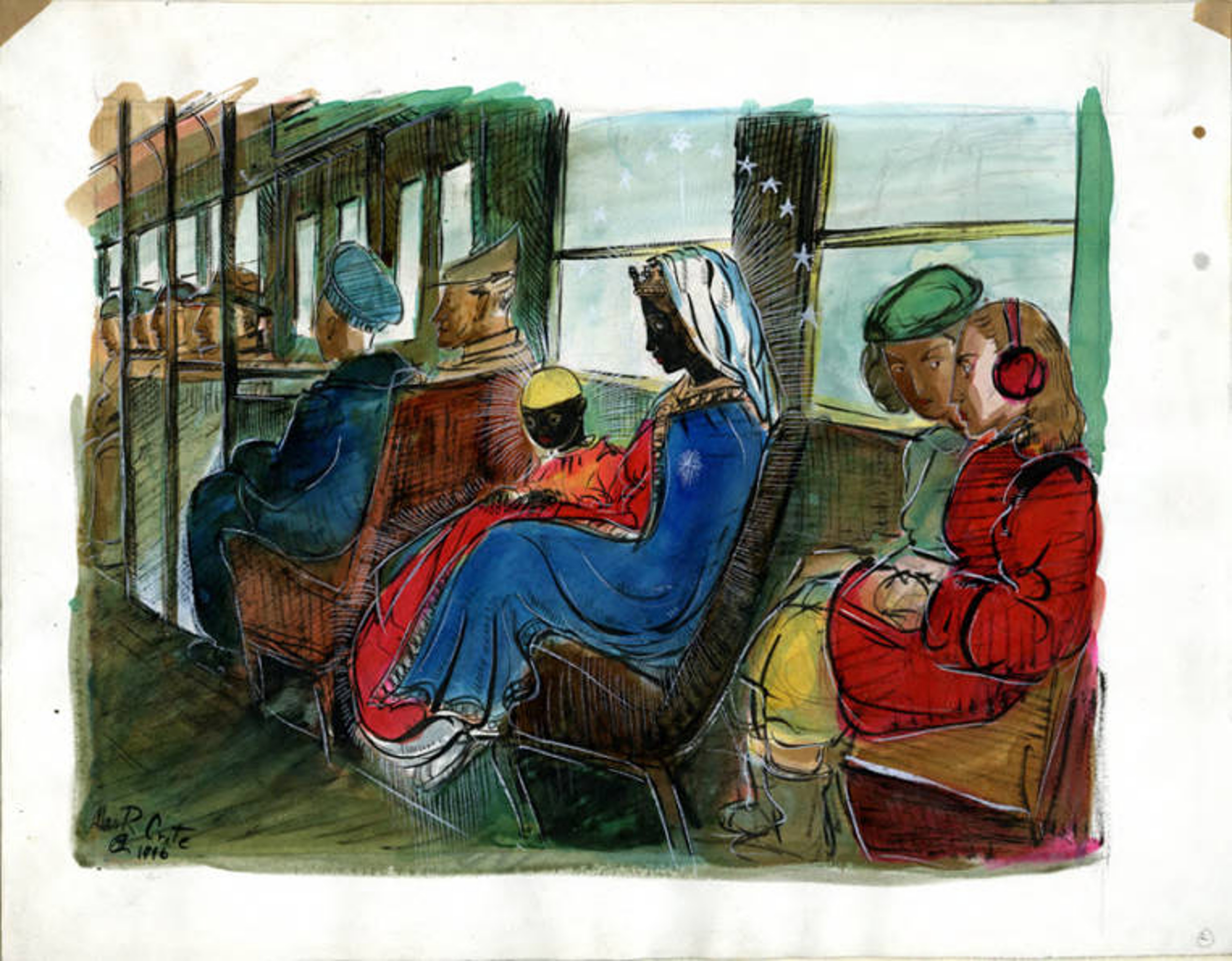
Figure 4. Streetcar Madonna (1946, Allan Rohan Crite). Watercolour with black ink and white gouache over graphite, 23.8 × 31.4 cm (9 3/8 × 12 3/8 in.). Boston Athenaeum, Gift of the artist, 1971 (A U9 Cri.a. 1946). Image courtesy of the Allan Rohan Crite Research Institute and Library.
The Madonna’s watchful gaze—the image’s structural device—turns looking into a reciprocal act of mirroring: the viewer looks at the Madonna, and the Madonna appears to look back. Like the Black Glass Madonna of Loreto—whose eyes seem to look inward and outward at once with unsettling intensity—Crite’s Madonna articulates this vigilance pictorially through the slight torque of the shoulders. This vigilance is fully embedded within a racially charged public space, nowhere more palpable than in the two white women seated behind her. Marked by suspicion, discomfort, and social policing, their counter-gaze, reinforced by their almost-whispering proximity, converges diagonally on the Madonna’s head, pressing against the pictorial surface itself. Accordingly, the vigilance becomes both devotional and defensive, guarding her child in an environment where she herself remains under scrutiny. The surface becomes a site of visual pressure, where reciprocal yet asymmetrical looking holds the sacred and the racialized everyday in unresolved tension. The pictorial miracle is sustained not despite the thinness of paper, but through it.
Crite’s strategy finds an unexpected historical resonance in the inverted pictorial structure of Velázquez’s Christ in the House of Martha and Mary (c. 1599), where the sacred remains spatially recessed at a much smaller scale behind Martha’s kitchen. Its pictorial identity—unresolved between window, framed image, and mirror— renders the recessed sacred an ephemeral presence held against the dense foreground of fish, shimmering mortar, and the two women, coexisting with the weight of gendered domestic labour on a single, flattened plane. The inversion foregrounds what Martha’s expression has long been read as signifying: a traditionally gendered conception of the feminine as confined to the earthly, with Christ representing sacred transcendence, calling the very idea of sacred space into question.
A comparable pictorial construction appears in Crite’s Untitled (Empty College Campus Facing Street, with Choirs of Yellow-Robed Angels in the Sky) (1959). Here the sky does not open into illusionistic depth but is articulated through rapid, passing traces of paint asserted directly on the paper’s surface. Broad white bands streak across the blue field—not as atmospheric recession but as forceful planar inscriptions. Though swiftly drawn, these marks generate a monumental architectural structure, their repeated arcs forming a frieze across the sky. Set against the grounded three-dimensionality of the buildings below, this planar field acquires a sacred charge not by opening upward into transcendence but by confronting the spatial texture of everyday life from the surface itself.
This thinning of the pictorial surface also defines the Christ Child. At first glance, he appears to be reading, quietly invoking the posture of engaging sacred text. Closer inspection, however, reveals that his hands hold nothing. His fingers rest lightly on his mother’s lap, only partially rendered and without anatomical completion. The child does not assert volumetric solidity but appears as a lightly inscribed presence sustained within the same attenuated surface as the Madonna and the surrounding passengers. He is neither fully absorbed into the everyday nor withdrawn from it. His presence persists through proximity and touch rather than bodily completion or sculptural weight.
Johnetta Tinker and Susan Thompson’s Deeply Rooted in the NeighborHOOD, homage to Allan Rohan Crite (2021), displayed above Crite’s Ancestors and Our Neighborhood (1984), translates everyday life into an expansive textile surface that resists the containment of a single architectural frame (figure 5). The boy’s bicycle, for instance, extends beyond the quilt’s edge rather than stopping at its boundary, while figures and objects spread laterally across the surface instead of being enclosed by framing.
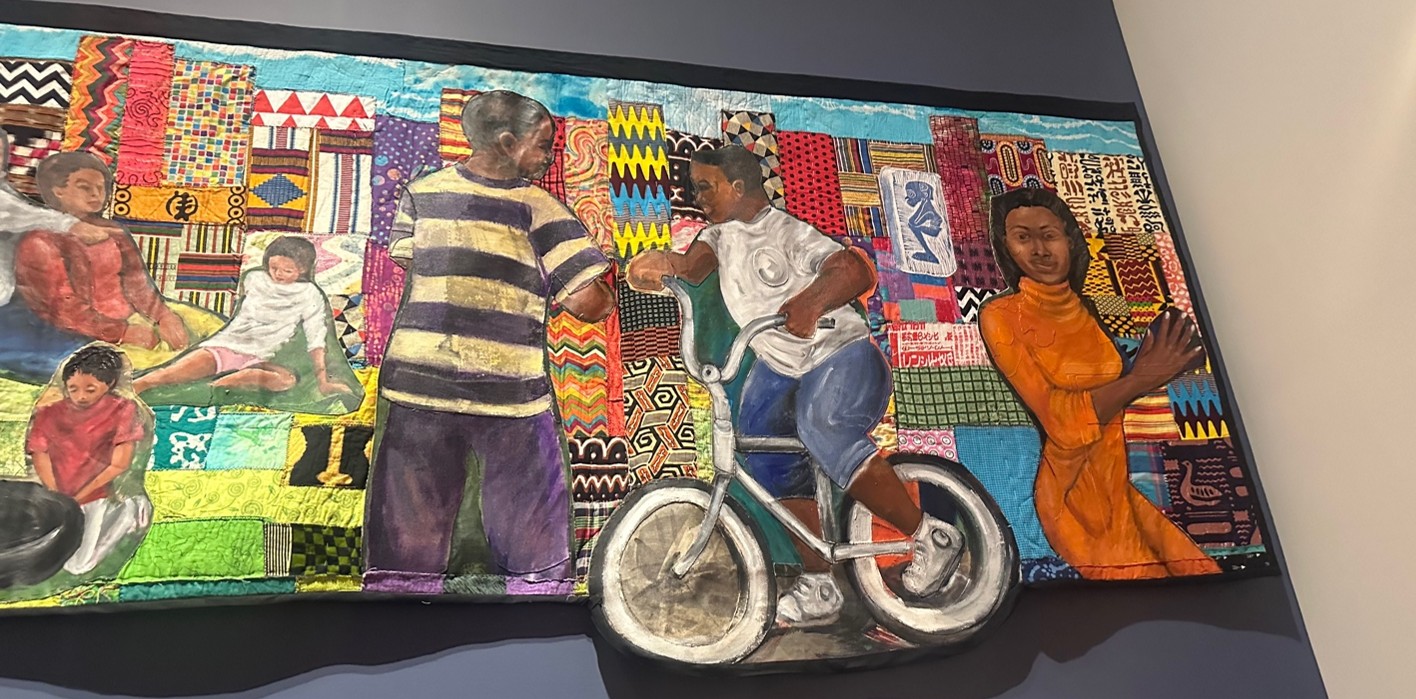
Figure 5. Deeply Rooted in the NeighborHOOD: Homage to Allan Rohan Crite (2021, Johnetta Tinker and Susan Thompson), partial view focusing on the framing of the boy on the bicycle. Mixed-media quilt with appliqué, two panels, each 104.1 × 226 cm. Produced by the Boston Public Art Triennial as part of Mentoring Mural. Photograph by the author, taken at the Isabella Stewart Gardner Museum, Boston.
Assembled from fragments, the quilt grows through accumulation rather than compression, producing extension rather than depth. Although the Black Madonna no longer visibly appears, the pictorial structure established throughout Crite’s work sustains the sense that she may re-emerge at any moment within the neighbourhood. The sacred thus persists where framing can no longer contain the surface itself.
Mesa-Bains (as discussed in the first part of this duology) and Crite offer different reflections of the Black Madonna, together mirroring the sacred across body and world. In Mesa-Bains’s Cihuateotl with Hand Mirror the Black Madonna incites reflections of multiple identities that constantly transform one another, while Crite builds a larger pictorial world in which racial difference remains visible yet becomes interconnected on a thin plane. Across Mesa-Bains, Crite, Tinker, and Thompson, the sacred emerges precisely when representation fails to contain it: when Venus’s body opens to the flickering presence of the Black Madonna; when the Black Glass Madonna’s gaze misleads, redirects, and transforms the viewer’s act of seeing; when a city bus becomes a chapel through little more than a halo of light; and when the edge of a quilt becomes the threshold through which devotional memory returns. The sacred appears whenever the frame becomes insufficient—when surface, temporality, race, gender, and everyday life interlace beyond the limits of iconography. Mirroring thus emerges not as resemblance but as a structure through which difference acts upon difference without requiring the dissolution of boundaries. This is the entangled sacred: woven from material surfaces, historical afterlives, and the instability of vision itself.
Black identity politics emerged from specific histories of enslavement, segregation, exclusion, and racial violence. To dissolve that specificity into the universal language of diversity would risk another erasure. Yet Crite’s images ask a different question: once difference becomes visible, what new relations can unfold where boundaries intersect? Every image distributes visibility—who occupies the centre, who remains peripheral, and which relations become imaginable.
The Glass Madonna’s complex material presence—the breakable density of glass—becomes the vulnerable thinness of paper; concentrated radiance becomes the lighter mobility of line. Yet this material leanness is not an absence of substance but a condition of openness. The Glass Madonna can shatter; the paper Madonna can tear. But paper can receive one line after another, one image beside another, leaving room for further histories to enter relation through mirroring within the sacred. Fragility creates the very matter of the sacred through which each Madonna becomes visible.
For those who have long worked from the margins of visibility, looking—closely and insistently—becomes a form of resistance. Yet the Black Madonna speaks beyond those margins. Suspended between the sacred and the social, reflection and absorption, she becomes an image of survival and transformation. Her mirrored skin gathers historical and contemporary gazes into a luminous opacity that exceeds every interpretive frame built to contain her. In this unstable field of seeing and being seen, vision is never neutral.
Two of Crite’s works on paper, though not included in the Gardner exhibition, extend a way of seeing generated by the exhibition itself, offering further clues to the interconnectedness already unfolding through the works on view. In one unfinished drawing of a sacred gathering (untitled, date unknown), in the collection of the National Center of Afro-American Artists, Crite’s world-building process becomes visible: much of the composition remains faintly outlined, while distinct physiognomies emerge with striking clarity. Crite’s world-building unfolds further through colour, opening a political possibility in his blue-and-white print of the Madonna and Child surrounded by angels (figure 6).[7] The deep blue ink that gives substance to the Blackness of the Madonna, Christ Child, and angels also shapes the trees, the darkness between rooftops, and the night itself. Crucially, blackness here is made visible not through black but through blue, unsettling any easy equivalence between racial Blackness, skin, and colour. Seen also as colour, blackness belongs not to the body alone but to the world—to trees, shadows, rooftops, and night. The image does not erase Black identity; it makes racialization unmistakably visible while refusing to confine the material colour that gives it form within the body’s boundary. In this sense, Crite’s blue ink brings into another form a possibility already present in the Black Glass Madonna of Loreto: difference remains visible, yet the matter through which it appears opens beyond any single boundary into further relations. Crite’s blue ink thus offers a quiet visual challenge: what has historically marked a boundary becomes, through matter, a site of relation—and relation makes a world.
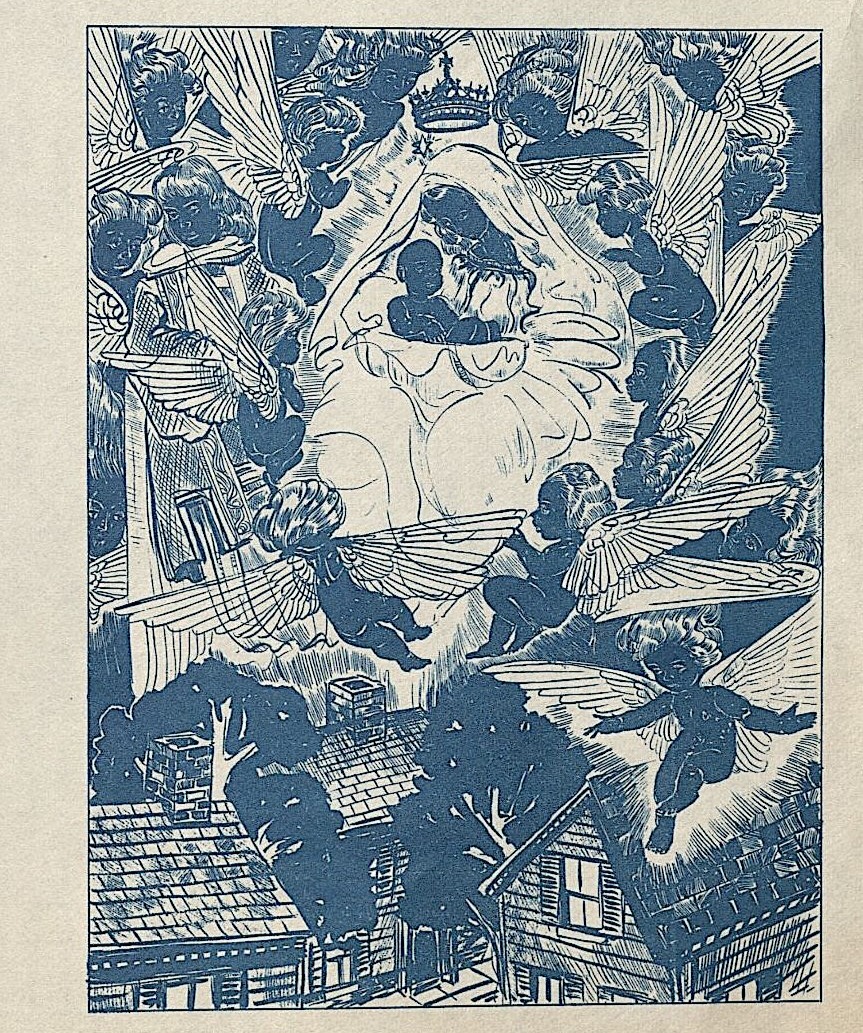
Figure 6. Untitled (date unknown, Allan Rohan Crite). Courtesy of the Marian Library, University of Dayton.
Across the Whitney and the Gardner exhibitions, the Black Madonna appears not only as an iconographic subject but as a visual structure emerging through a mirrored field of vision. Reflection, material opacity, and reciprocal looking reorganize the relations between image, viewer, and space, revealing sacred visibility as something produced through looking rather than residing in the image alone. Appearance and disappearance remain inseparable.
By tracing the movement from reflective emergence to material presence, I propose mirroring as a critical structure of spectatorship through which contemporary art reactivates historical forms of sacred visibility. Within this mirrored field, the sacred becomes perceptible not as a fixed symbol but through unstable relations among surface, materiality, and the act of looking—relations that continually reshape one another.
In this sense, the visual is most political when it reveals complex racialized and gendered relations that familiar political categories, necessary as they are, cannot fully contain.
[1] Monique Scheer, “From Majesty to Mystery: Change in the Meanings of Black Madonnas from the Sixteenth to Nineteenth Centuries,” The American Historical Review, 107:5 (2002), pp. 1412–40, esp. p. 1418.
[2] Such reciprocity resonates with the vertiginous visual relations through the mirror described by San Juan, yet here it emerges from the material capacity of black glass. See: Rose Marie San Juan, Vertiginous Mirrors: The Animation of the Visual Image and Early Modern Travel (Manchester: Manchester University Press, 2011), pp. 56–67.
[3] Isabella Stewart Gardner Museum, Visions of Black Madonnas. Exhibition wall text, Isabella Stewart Gardner Museum, Boston, 23 October 2025–19 January 2026.
[4] Isabella Stewart Gardner Museum, Visions of Black Madonnas, exhibition wall text, 2025–26.
[5] Isabella Stewart Gardner Museum, Meet Isabella & Her Museum (Boston, 2025), museum brochure.
[6] Victor I. Stoichita, The Self-Aware Image: An Insight into Early Modern Meta-Painting, trans. Anne-Marie Glasheen (Cambridge: Cambridge University Press, 1997), pp. xiii–xiv, 3–10, 111.
[7] Unfortunately, both the title and date of this print are unknown. I am grateful to the Marian Library at the University of Dayton for generously granting permission to reproduce the image. Readers with any further information about the work are kindly invited to contact either the Marian Library or the author.
Black Glass Madonna (1570–1591), Innsbruck Court Glassworks (active Innsbruck, 1570–1591). Lampworked and pressed glass on wood mount, 52.5 × 28.8 cm (20 11/16 × 11 5/16 in.). Isabella Stewart Gardner Museum, Boston. Image courtesy of the Isabella Stewart Gardner Museum.
Dr Sena Lee is a New York-based art historian who received her PhD in History of Art from University College London. Her research explores how mythological pictorial space was re-framed in seventeenth-century Italy and Spain through the intersection of different visual languages of painting (such as layering, splitting, mirroring, and framing). More recently, she has extended this approach to contemporary visual culture, examining the structures that emerge through the intersection of museum display, sacred imagery, and race.
Sena Lee, “Mirroring the sacred (II),” JVC Magazine, 19 July 2026, https://journalofvisualculture.org/mirroring-the-sacred-II/.